Open the exact family listing to compare the live price, availability, delivery, seller, and returns.
Choose a desk chair mat by hard floor or carpet, pile and pad depth, chair travel, mat thickness, edge profile, backing, desk shape, cleaning, and trip risk.
Prepared by the Deskwise Picks editorial deskUpdated August 11, 2026
Quick answer
The practical answer
Match the mat to the exact surface: smooth-backed protection for hard floors and an appropriate cleated or rigid design for measured carpet-plus-pad depth. Trace the chair's real movement under and around the desk, then choose enough area without placing an edge in a walking path. Confirm load, temperature unrolling instructions, edge profile, finish compatibility, and return terms before flattening it permanently.
Common buying question
What size and thickness office chair mat should I buy for carpet or hardwood without cracking, sliding, or creating a trip edge?
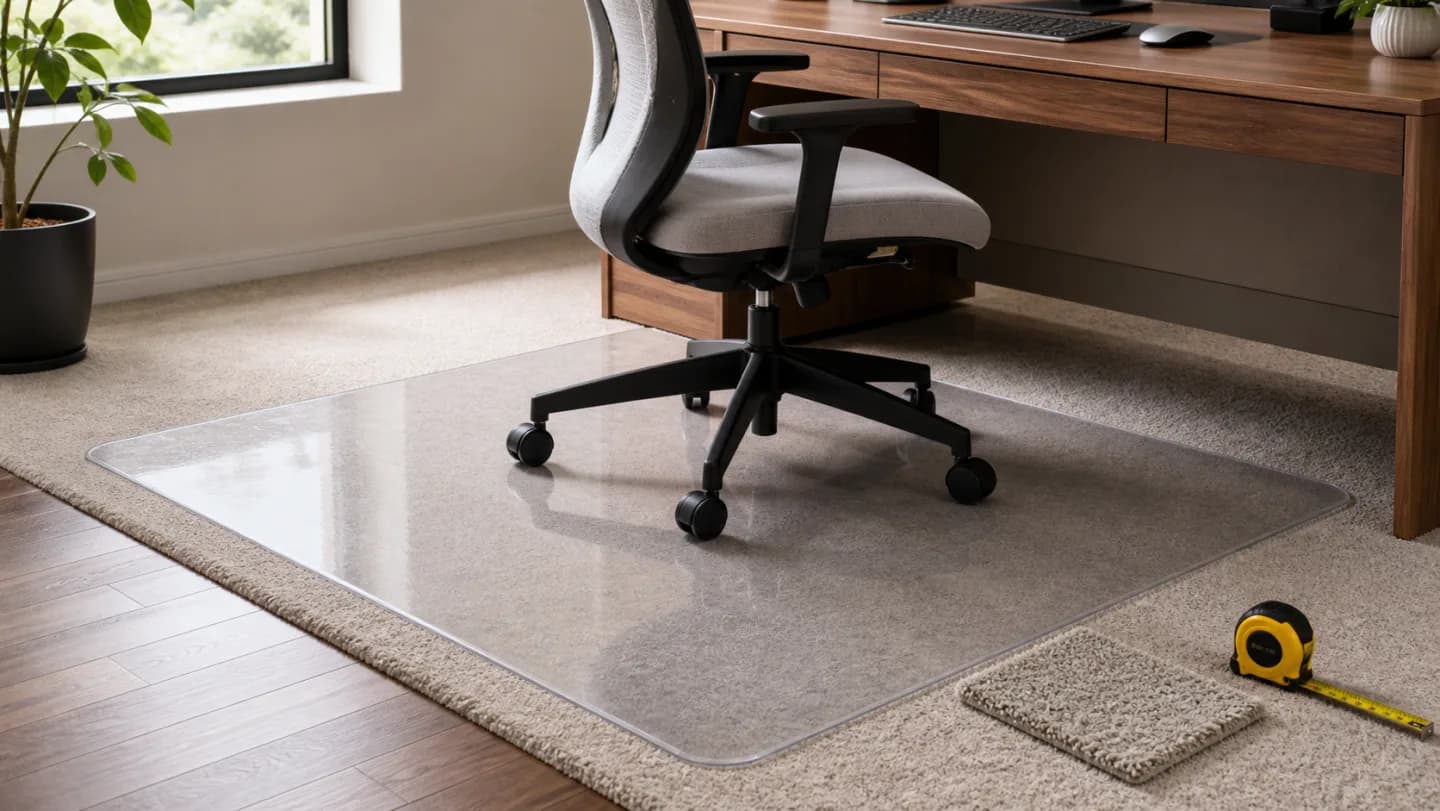
Original editorial image for category, fit, and use context; verify the exact linked product appearance and configuration on the retailer page.
Measure the chair's working envelope
Sit through normal typing, video calls, drawer access, standing transitions, and exit directions, then mark where every caster travels. Add the desk legs and walking path. A mat that looks large in product photography can be too narrow behind the chair, while an oversized sheet can place a flexible edge exactly where feet cross the room.
Match stiffness and backing to the floor
Hard floors need a backing that resists sliding without staining or chemically interacting with the finish. Carpet requires enough rigidity for measured pile and pad depth, plus anchors designed for that construction. Do not use sharp cleats on wood or assume a label for low-pile carpet covers plush carpet with a thick cushion underneath.
Account for caster point load
The combined chair and user load is concentrated through a handful of small wheels. Narrow hard casters sink more deeply and can stress a thin plastic mat. Compare material and thickness claims, but remember that dimensions and formulation vary. Wide soft casters may improve rolling, yet they still need a mat and floor approved for their load.
Control curl, slide, and trip edges
Follow warm-up and flattening instructions and do not force a cold rolled mat flat. Position lips fully under the desk, keep corners away from doors, and inspect every edge from the approach direction. If the mat migrates or a corner lifts, stop using it until the surface and fit are corrected; tape is not always compatible with flooring.
Protect the floor under the protector
Grit under a mat can abrade finish, while trapped moisture can cloud or discolor some surfaces. Lift, clean, and dry the area on a regular schedule, following both floor and mat instructions. Check early for marks, odor, cracking, or edge whitening, and preserve return packaging until the mat has flattened and performed through normal chair movement.
Current Amazon option
Check this exact product
Kuyal Clear Chair mat for Hardwood Floor, 36 x 48 inches | Transparent Floor Mats Wood/Tile Protection Mat for Office & Home (36" X 48" Rectangle)
ASIN
B0893BD69B
Brand
Kuyal
Listing checked
8/11/2026
Compare the current title, ASIN, variant, seller, stock, shipping, price, and return path before ordering.
Exact US listing reference. Confirm the selected variation, seller, included parts, live availability, and any applicable recall notice before buying.
Public owner context
Questions to answer before buying
Community discussions help surface installation, fit, maintenance, and failure questions. They are anecdotal context, not product specifications or a substitute for current instructions.
Used to locate real owner questions and failure reports that shape the inspection checklist. Anecdotes are not presented as measured product tests or copied as endorsements.
Research notes
How we evaluated these choices
1.Tape paper or painter's tape around a week of real chair movement before choosing dimensions.
2.Measure carpet and pad depth or confirm the hard-floor finish and manufacturer's mat restrictions.
3.Compare mat material, thickness, backing, caster load, edge profile, and flattening instructions for the exact SKU.
4.Install with walking edges visible, inspect for slide or curl, and lift periodically to clean and check the floor.