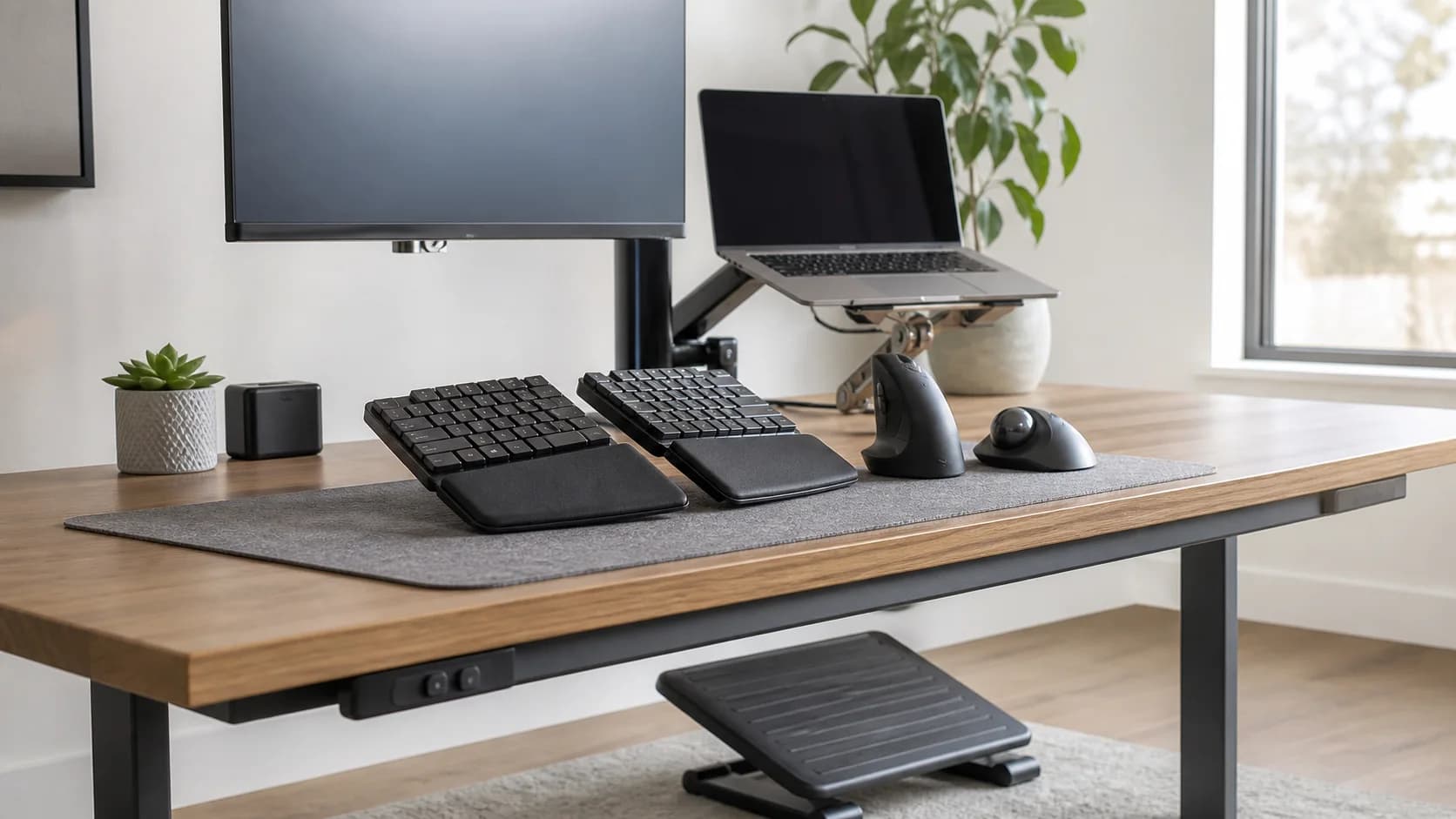
Fix workstation height before buying a thinner board
OSHA advises placing the keyboard directly in front, keeping shoulders relaxed and wrists in line with the forearms. Measure the work surface, chair, keyboard front height, and mouse position together. A thin case cannot compensate for a desk that is too high, and raised rear feet can make wrist extension worse for some users.
Audit the exact layout in the software you use
Write down the keys used every day: function row, navigation cluster, arrows, number pad, media controls, screenshot, Insert, Delete, and operating-system modifiers. Compact low-profile layouts move or layer some of them. Rehearse spreadsheets, code, creative shortcuts, remote desktops, and login screens; remapping software may not run everywhere.
Choose feel and sound with a real sample
Scissor, tactile, clicky, and linear labels do not describe the complete board. Case resonance, keycaps, stabilizers, desk surface, typing force, and bottoming out all affect sound and feel. Logitech's MX Mechanical illustrates that one low-profile family can ship with tactile, clicky, or linear switches. Test the exact switch in the room and calls where it will be used.
Test every connection and recovery path
Pair or connect each required computer, then test device switching, wake from sleep, reconnect after restart, firmware tools, wired fallback, receiver storage, charging while working, and shortcut mapping on each OS. If the mouse must sit farther away because of a full-size board, compare a tenkeyless board plus a movable number pad before accepting the reach.
Buying decision: the decision
Start with layout and dedicated navigation keys and switch feel and travel, not the longest feature list. Buy only when the product can keep the hands closer to desk height with shorter key travel and a thinner case, the setup is realistic, and the household accepts nonreplaceable switches or keycaps, battery aging, proprietary receivers, cleaning, and limited repair options. Skip it when the shallow travel causes errors or fatigue, the layout removes critical keys, or a properly positioned standard keyboard already fits.
Compatibility and fit: the decision
Compatibility passes only when all four checks are confirmed: layout and dedicated navigation keys; switch feel and travel; front height and wrist position; multi-device switching, battery, and receiver. Verify the exact model and variant, then test the limiting condition before the return window closes.
Ownership cost and maintenance: the decision
The real ownership budget for low-profile keyboards includes nonreplaceable switches or keycaps, battery aging, proprietary receivers, cleaning, and limited repair options. Record a baseline for layout and dedicated navigation keys and switch feel and travel, monitor front height and wrist position and multi-device switching, battery, and receiver, and keep the previous routine available until an ordinary failure can be recovered without guesswork.
Setup and daily workflow: the decision
Use this order: compare front height with the current desk, test sustained typing rather than a few keystrokes, and configure switching for the actual computers. Keep the previous routine available until normal operation and a safe recovery test both work.