Deskwise Picks
Browse
Meetings

Dual-screen Portable Monitors vs. single portable monitors

Current retailer option

InnoView Portable Dual Monitor 15.6" 1920x1080 Dual Stacked Foldable Monitor | 315° Screen Adjustment | USB-C/HDMI Second Monitor for Laptop, Mac, Windows

Check current price & availability on Amazon

Current price & availability · purchase link

Open the exact family listing to compare the live price, availability, delivery, seller, and returns.

Choose a freestanding dual portable monitor, a laptop-mounted screen extender, or one conventional monitor by host display limits, cable count, travel weight, desk depth, and the way the screens are supported.

Prepared by the Deskwise Picks editorial deskUpdated October 6, 2026

Quick answer

The practical answer

Start with the laptop, not the display bundle. Confirm how many external displays the exact computer supports, which ports carry video, and whether each screen needs separate power. Choose a freestanding stacked monitor when the desk can support it without loading the laptop lid; choose a lid-mounted extender only when the laptop, hinge, screen size, travel weight, and cable path all pass. A permanent desk monitor is usually the simpler choice when portability is not part of the job.

Complete topic guide

One page for the complete decision

Comparison, compatibility, ownership, maintenance, and setup guidance are now consolidated below. This keeps every useful check while removing separate pages that competed for the same family-level decision.

Common buying question

Should you choose dual-screen portable monitors or single portable monitors for this job?

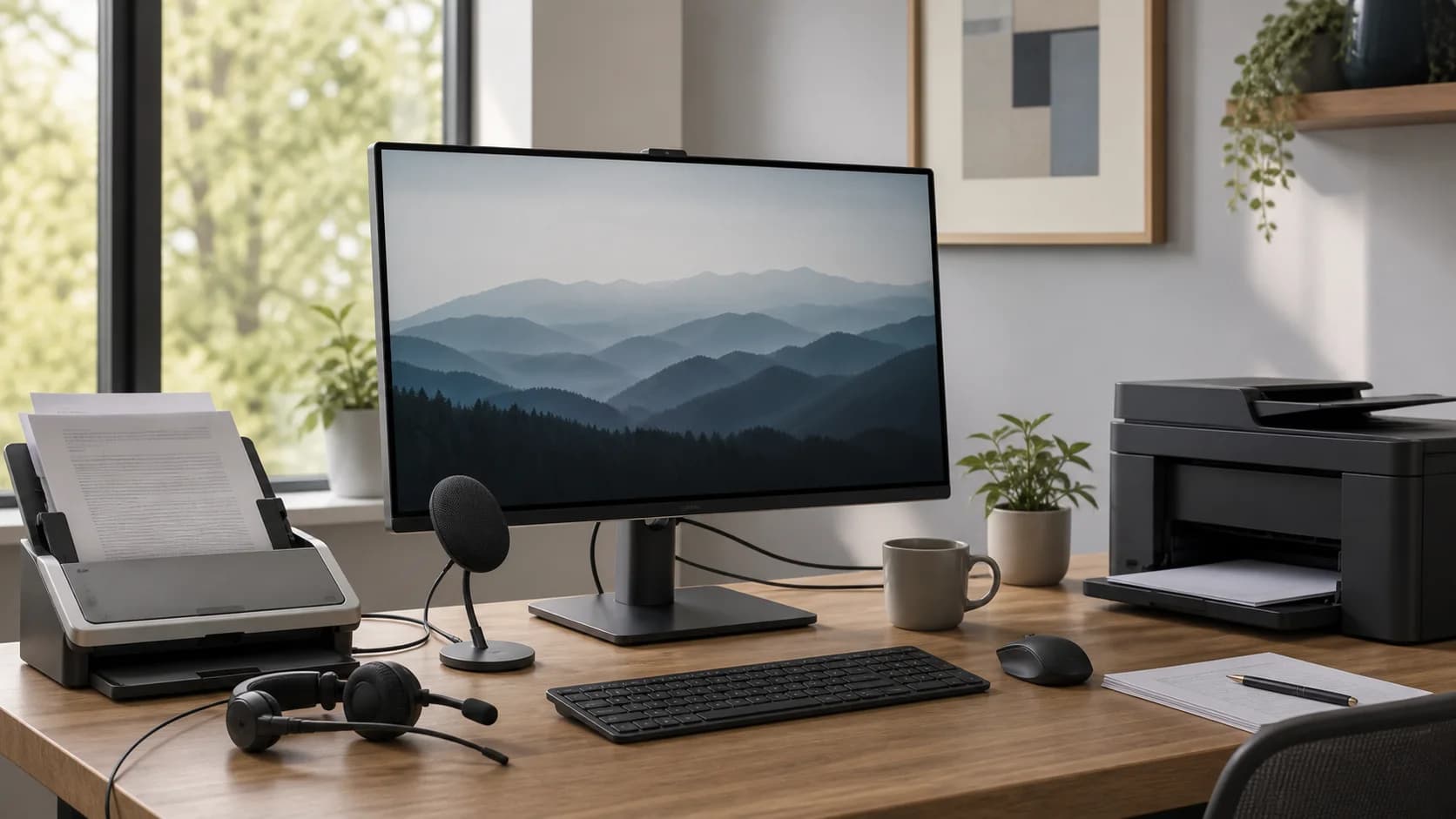
Original editorial scene with unbranded meeting, display, audio, scanning, and printing equipment
Original editorial image for category, fit, and use context; verify the exact linked product appearance and configuration on the retailer page.

Write the host display limit before comparing screens

Record the exact laptop model, chip or GPU, operating system, available ports, and the number of external displays the manufacturer supports. Identical USB-C connectors can expose different video capabilities. Apple explicitly ties display count to the Mac model plus resolution and refresh rate; a display accessory cannot raise that host limit simply because it has two panels.

Draw one cable and power path per panel

For each screen, write the source port, cable, adapter, power source, target resolution, and refresh rate. Confirm whether one USB-C connection carries video and sufficient power or whether a second cable is required. A tidy product photo is not evidence that the exact laptop will drive both panels from one port.

Separate screen support from portability

A freestanding stacked unit puts weight on its own stand but needs desk depth and a stable surface. A lid-mounted extender reduces stand clutter but transfers load and leverage to the laptop. Test hinge movement, vent clearance, webcam clearance, cable strain, and the ability to type without screen movement before the return window closes.

Run a real pack-and-work trial

Pack the displays, stand, power supply, adapters, and protective case, then set up at the smallest surface you actually use. Check total carried weight, setup time, screen stability, sleep-and-wake recovery, and whether the laptop can still be positioned comfortably. If the equipment stays on one desk, compare a normal monitor before paying a portability premium.

Buying decision: the decision

Start with laptop width, lid strength, and mounting method and USB-C video outputs and driver needs, not the longest feature list. Buy only when the product can add two travel displays to a laptop when mobile workspace outweighs weight and cable complexity, the setup is realistic, and the household accepts hinges, sliding rails, cables, drivers, luggage protection, desk depth, and setup time at every location. Skip it when the laptop lid flexes, two outputs require unreliable software, or one light portable monitor provides most of the productivity gain.

Compatibility and fit: the decision

Compatibility passes only when all four checks are confirmed: laptop width, lid strength, and mounting method; USB-C video outputs and driver needs; total power draw and cable count; combined carry weight, resolution, and stand stability. Verify the exact model and variant, then test the limiting condition before the return window closes.

Ownership cost and maintenance: the decision

Budget beyond checkout for hinges, sliding rails, cables, drivers, luggage protection, desk depth, and setup time at every location. The disciplined choice is the one that remains serviceable and recoverable after normal wear, cleaning, updates, consumables, or a failed part.

Setup and daily workflow: the decision

Set up dual-screen portable monitors in this order: confirm both video paths, assemble on a stable desk, support the laptop lid, test power from the real travel charger, and pack protective spacers. Put laptop width, lid strength, and mounting method and USB-C video outputs and driver needs on the installation checklist, then build the repeatable routine around total power draw and cable count and combined carry weight, resolution, and stand stability. Revert if the laptop lid flexes, two outputs require unreliable software, or one light portable monitor provides most of the productivity gain.

Current Amazon option

Check this exact product

InnoView Portable Dual Monitor 15.6" 1920x1080 Dual Stacked Foldable Monitor | 315° Screen Adjustment | USB-C/HDMI Second Monitor for Laptop, Mac, Windows

ASIN
B0FNRNK72C
Brand
InnoView
Listing checked
8/9/2026

Compare the current title, ASIN, variant, seller, stock, shipping, price, and return path before ordering.

Side-by-side checks

Portable dual monitor, lid extender, or desk monitor?

CheckFreestanding dual portable monitorLaptop-mounted extenderConventional desk monitor
SupportIts own stand on a stable surfaceLaptop lid and hinge carry the assemblyPermanent stand or monitor arm
Host checkTwo video streams, ports, cables, and powerExact laptop size plus supported display countOne supported video path per display
Best useRepeatable temporary desk with more screen areaCompact all-in-one travel setup after a fit testDaily fixed workstation
Skip whenDesk depth or cable count makes setup fragileThe lid flexes, vents are blocked, or weight is excessiveThe workstation must pack and move often

Primary sources

References used for this guide

Public owner context

Questions to answer before buying

Community discussions help surface installation, fit, maintenance, and failure questions. They are anecdotal context, not product specifications or a substitute for current instructions.

  • Reddit community discussion

    Dual-monitor KVM setup works, but only sometimes

    A public owner discussion used to identify questions and failure modes. Comments are anecdotal; no username, vote count, rating, or verbatim review is reproduced, and product facts must be verified independently.

Research notes

How we evaluated these choices

  1. 1.Define one independent purchase or use question for this URL.
  2. 2.Verify the four family-specific dimensions: laptop width, lid strength, and mounting method; USB-C video outputs and driver needs; total power draw and cable count; combined carry weight, resolution, and stand stability.
  3. 3.Use an exact Amazon ASIN only as a current retailer identity and checkout anchor, not as hands-on evidence.
  4. 4.Separate public community discussion from official specifications and editorial judgment.
  5. 5.Keep a written stop condition and a reversible test path.
  6. 6.Research-synthesis decision worksheet using current manufacturer support documentation. No hands-on display, hinge-load, brightness, color, or travel test is claimed.

Related guide

Video Call Setup Guide for Home Offices

A practical path to better Zoom, Meet, and Teams calls using light placement, camera height, audio basics, and desk layout.

Related guide

USB Switch vs. KVM vs. Dock for Two Computers

Choose the device by what must move between computers: peripherals, displays, charging, Ethernet, or the entire desk.

Related guide

USB Speakerphone vs. Headset for Video Meetings

Choose by room occupancy, privacy, background noise, comfort, pickup distance, and whether several people need one audio device.

Related guide

DP Alt Mode Driver vs DisplayLink: Portable Monitor Guide

Work out whether your portable monitor needs native DisplayPort video, a DisplayLink driver, or HDMI before replacing cables or installing software.

Related guide

Monitor-Mounted Key Light vs. Desk Lamp for Video Calls

Choose the fixture by camera axis, face distance, desk depth, monitor strength, task-light needs, cable path, and the amount of room light it must overcome.

Related guide

Key Light Placement for Glasses: Reduce Video-Call Glare

Move the light, camera, screen, and glasses angle before buying a brighter panel; use a repeatable placement test that preserves eye light without reflecting a white rectangle.

Related guide

Business USB-C Monitors vs. monitors plus a separate dock

Compare a USB-C hub monitor with a separate dock by host video support, charging wattage, USB and Ethernet needs, second-monitor topology, desk ownership, and replacement risk.

Related guide

Ultrawide Office Monitors Buying Guide

Which ultrawide office monitors are worth buying when the real job is to replace two display workspaces with one wide canvas and fewer bezel interruptions? This guide turns that question into model-level checks, a reversible setup, a first-year ownership plan, and a clear skip decision.