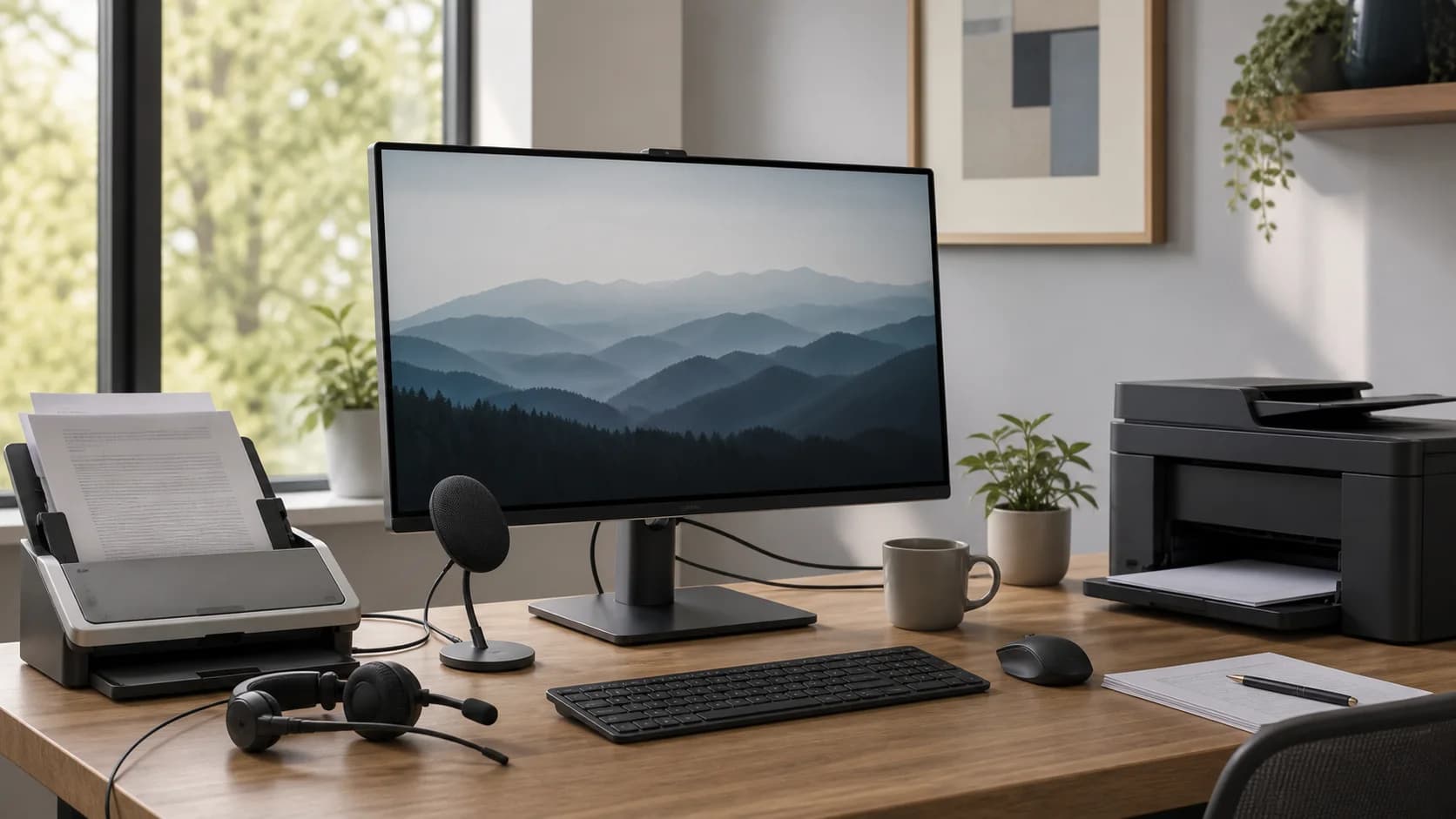
Start with the job: move between calls and focused work without giving up a dedicated boom microphone
Wireless conference headsets should earn their cost and ongoing effort by solving that repeated job, not by winning on a larger specification number, a dramatic desk photo, or a feature that adds switching friction. Before comparing listings, record the worker, posture, desk dimensions, computer and operating system, ports, power, cable reach, storage, meeting routine, and the task that is currently slow or uncomfortable. Then compare the product with wired usb headsets under the same real conditions and for the same period.
The first two buying checks are Bluetooth versus dedicated receiver and multi-device connection
For wireless conference headsets, Bluetooth versus dedicated receiver and multi-device connection usually eliminate more poor choices than a long feature comparison. Confirm both from the exact current product details or instructions. If either depends on a driver, dock, cable, adapter, mount, power supply, operating-system feature, desk clearance, or assembly service, include that dependency in the purchase and setup plan rather than treating it as a later detail.
Do not ignore talk time and charging dock or ANC, transparency, boom mute, and meeting-platform certification
For this wireless conference headsets decision, talk time and charging dock and ANC, transparency, boom mute, and meeting-platform certification determine whether a product that looks correct online will still work in the real use case. Measure or test the limiting condition across the actual desk, body position, computer, operating system, cable reach, workday, and shared-device routine; preserve packaging and use the return period to reproduce the most demanding normal task rather than an ideal demonstration.
Price the complete first year
The family-specific ownership plan includes battery aging, replacement cushions, firmware utility, receiver loss, charging-dock space, and switching confusion across devices. Also price cables, adapters, software, replacement parts, consumables, warranty handling, power, and the cost of returning a poor fit. A lower checkout price is not better when it creates repeated work or leaves the household unable to recover from a common failure.
Keep a written skip decision
Do not buy when the radio environment is unreliable, calls exceed battery life, or a wired headset avoids the exact switching problem. That is not a missing premium feature; it is evidence that the product does not fit the current job. Keep the simpler wired usb headsets route available until the new option passes fit, normal use, maintenance, and recovery checks.
Compare the alternatives: the short answer
Wireless conference headsets are the stronger choice when their specialized path can move between calls and focused work without giving up a dedicated boom microphone. Choose wired usb headsets when it reaches the same outcome with fewer fit, setup, or maintenance dependencies—especially when the radio environment is unreliable, calls exceed battery life, or a wired headset avoids the exact switching problem.
Compare the alternatives: Wireless conference headsets and wired USB headsets: the decision dimensions
Primary job: Wireless conference headsets — Best when the product can move between calls and focused work without giving up a dedicated boom microphone.; wired USB headsets — Best when the same outcome needs fewer specialized dependencies. Check 1: Wireless conference headsets — Verify Bluetooth versus dedicated receiver.; wired USB headsets — Confirm the alternative removes or simplifies Bluetooth versus dedicated receiver. Check 2: Wireless conference headsets — Verify multi-device connection.; wired USB headsets — Confirm the alternative removes or simplifies multi-device connection. Check 3: Wireless conference headsets — Verify talk time and charging dock.; wired USB headsets — Confirm the alternative removes or simplifies talk time and charging dock. Check 4: Wireless conference headsets — Verify ANC, transparency, boom mute, and meeting-platform certification.; wired USB headsets — Confirm the alternative removes or simplifies ANC, transparency, boom mute, and meeting-platform certification. Skip signal: Wireless conference headsets — Skip when the radio environment is unreliable, calls exceed battery life, or a wired headset avoids the exact switching problem.; wired USB headsets — Prefer the alternative only after confirming it solves the same repeated problem.
Compare the alternatives: The real fork is specialized function versus wired usb headsets
Wireless conference headsets win when they can move between calls and focused work without giving up a dedicated boom microphone and that function removes a known recurring problem. wired USB headsets win when they reach the same outcome with fewer dependencies, less maintenance, a more understandable failure mode, or a cleaner return path.
Compare the alternatives: Normalize Bluetooth versus dedicated receiver and multi-device connection
Compare both paths across the same desk, body position, computer, operating system, cable reach, workday, and shared-device routine, with every required dependency included. A complete wireless conference headsets package should not be compared with an incomplete alternative, and a retailer headline should not replace product-level compatibility evidence.
Compare the alternatives: Use talk time and charging dock and ANC, transparency, boom mute, and meeting-platform certification as tie-breakers
In a wireless conference headsets comparison, talk time and charging dock and ANC, transparency, boom mute, and meeting-platform certification reveal the friction that appears after an attractive demo. Choose the path that can be installed, used, cleaned, updated, and recovered by the people who will actually own it. Prefer the simpler failure mode when performance is otherwise close.
Compare the alternatives: Compare ownership, not only purchase price
Wireless conference headsets bring an ownership path of battery aging, replacement cushions, firmware utility, receiver loss, charging-dock space, and switching confusion across devices. Price that against the maintenance and replacement work of wired usb headsets over one normal year. Include the value of time and the cost of losing the service while a proprietary part, account, or repair is unavailable.
Compare the alternatives: Make the choice reversible
Use this test path before the return window closes: pair only the needed devices, update firmware, test switching and mute in the real apps, and run a full workday battery test. Preserve the old setup and packaging until the product survives normal use. Choose the alternative immediately when the radio environment is unreliable, calls exceed battery life, or a wired headset avoids the exact switching problem.
Compatibility and fit: the short answer
Compatibility passes only when all four checks are confirmed: Bluetooth versus dedicated receiver; multi-device connection; talk time and charging dock; ANC, transparency, boom mute, and meeting-platform certification. Verify the exact model and variant, then test the limiting condition before the return window closes.
Compatibility and fit: Compatibility checks that change the wireless conference headsets decision
Decision 1: What to verify — Bluetooth versus dedicated receiver; Decision effect — Treat any unanswered question about Bluetooth versus dedicated receiver as a reason to pause rather than assume fit. Decision 2: What to verify — multi-device connection; Decision effect — Treat any unanswered question about multi-device connection as a reason to pause rather than assume fit. Decision 3: What to verify — talk time and charging dock; Decision effect — Treat any unanswered question about talk time and charging dock as a reason to pause rather than assume fit. Decision 4: What to verify — ANC, transparency, boom mute, and meeting-platform certification; Decision effect — Treat any unanswered question about ANC, transparency, boom mute, and meeting-platform certification as a reason to pause rather than assume fit. Setup proof: What to verify — pair only the needed devices, update firmware, test switching and mute in the real apps, and run a full workday battery test; Decision effect — Complete this path before retiring the previous routine or equipment. Exit condition: What to verify — the radio environment is unreliable, calls exceed battery life, or a wired headset avoids the exact switching problem; Decision effect — Use wired usb headsets or keep the current setup when this condition applies.
Compatibility and fit: Compatibility check 1: Bluetooth versus dedicated receiver
For wireless conference headsets, record the exact value, standard, measurement, or supported condition behind Bluetooth versus dedicated receiver before checkout. A broad category label does not prove that the selected variant fits. Confirm the manufacturer, complete model, hardware revision, operating-system support, port layout, dimensions, power supply, and included cables rather than assuming similarly named products share limits.
Compatibility and fit: Compatibility check 2: multi-device connection
Test multi-device connection across the actual desk, body position, computer, operating system, cable reach, workday, and shared-device routine—not a product-photo setup. If this wireless conference headsets fit depends on a driver, dock, cable, adapter, mount, power supply, operating-system feature, desk clearance, or assembly service, confirm the exact part, service, or behavior as part of compatibility.
Compatibility and fit: Compatibility checks 3 and 4: talk time and charging dock; ANC, transparency, boom mute, and meeting-platform certification
For wireless conference headsets, talk time and charging dock and ANC, transparency, boom mute, and meeting-platform certification are the limiting conditions most likely to surface only after installation. Measure the smallest clearance, weakest connection, least compatible user or device, and the most demanding normal task. Passing an ideal bench test is not enough.
Compatibility and fit: Prove fit in a reversible order
Use this sequence: pair only the needed devices, update firmware, test switching and mute in the real apps, and run a full workday battery test. Keep labels, packaging, manuals, and the previous system until the product works through normal use and a recovery test. Photograph wiring, measurements, or assembly states that would be difficult to reconstruct.
Compatibility and fit: A failed fit check is a stop signal
Stop when the radio environment is unreliable, calls exceed battery life, or a wired headset avoids the exact switching problem. Do not repair a fundamental mismatch with unapproved accessories, copied settings, or community anecdotes. Use wired usb headsets when it meets the job with a clearer compatibility path.
Ownership cost and maintenance: the short answer
Budget beyond checkout for battery aging, replacement cushions, firmware utility, receiver loss, charging-dock space, and switching confusion across devices. The disciplined choice is the one that remains serviceable and recoverable after normal wear, cleaning, updates, consumables, or a failed part.
Ownership cost and maintenance: Ownership checks that change the wireless conference headsets decision
Decision 1: What to verify — Bluetooth versus dedicated receiver; Decision effect — Treat any unanswered question about Bluetooth versus dedicated receiver as a reason to pause rather than assume fit. Decision 2: What to verify — multi-device connection; Decision effect — Treat any unanswered question about multi-device connection as a reason to pause rather than assume fit. Decision 3: What to verify — talk time and charging dock; Decision effect — Treat any unanswered question about talk time and charging dock as a reason to pause rather than assume fit. Decision 4: What to verify — ANC, transparency, boom mute, and meeting-platform certification; Decision effect — Treat any unanswered question about ANC, transparency, boom mute, and meeting-platform certification as a reason to pause rather than assume fit. Setup proof: What to verify — pair only the needed devices, update firmware, test switching and mute in the real apps, and run a full workday battery test; Decision effect — Complete this path before retiring the previous routine or equipment. Exit condition: What to verify — the radio environment is unreliable, calls exceed battery life, or a wired headset avoids the exact switching problem; Decision effect — Use wired usb headsets or keep the current setup when this condition applies.
Ownership cost and maintenance: Build the cost beyond checkout
Normal ownership includes battery aging, replacement cushions, firmware utility, receiver loss, charging-dock space, and switching confusion across devices. Put those items beside the purchase price before comparing products, then add cables, adapters, software, replacement parts, consumables, warranty handling, power, and the cost of returning a poor fit and the cost of downtime.
Ownership cost and maintenance: Maintenance starts with Bluetooth versus dedicated receiver and multi-device connection
For wireless conference headsets, Bluetooth versus dedicated receiver and multi-device connection are not only buying checks; they determine what must be inspected, cleaned, updated, calibrated, charged, or replaced. Confirm that service points remain reachable after installation and that parts are sold for the exact model rather than only for a similar family name.
Ownership cost and maintenance: Watch talk time and charging dock and ANC, transparency, boom mute, and meeting-platform certification over the first year
Record the wireless conference headsets baseline for talk time and charging dock and ANC, transparency, boom mute, and meeting-platform certification after setup and check it after ordinary use. Ownership problems are easier to catch when settings, measurements, supply part numbers, and photos are documented before wear, firmware changes, seasonal conditions, or a different user changes the result.
Ownership cost and maintenance: Price failure and recovery
For wireless conference headsets, ask what happens after loss of power, video, USB, network, driver support, saved settings, a consumable, or an adjustable part. Keep the instructions, warranty, exact product identity, data-removal steps where applicable, and a practical fallback. The previous wired usb headsets routine should remain available until recovery is proven.
Ownership cost and maintenance: Know the economic stop point
Exit when the radio environment is unreliable, calls exceed battery life, or a wired headset avoids the exact switching problem. Also stop spending when recurring parts, service, cleaning, or recovery work exceeds the value of the repeated job. A familiar alternative is often cheaper than extending ownership of a mismatched specialized product.
Setup and daily workflow: the short answer
Use this order: pair only the needed devices, update firmware, test switching and mute in the real apps, and run a full workday battery test. Keep the previous routine available until normal operation and a safe recovery test both work.
Setup and daily workflow: Workflow checks that change the wireless conference headsets decision
Decision 1: What to verify — Bluetooth versus dedicated receiver; Decision effect — Treat any unanswered question about Bluetooth versus dedicated receiver as a reason to pause rather than assume fit. Decision 2: What to verify — multi-device connection; Decision effect — Treat any unanswered question about multi-device connection as a reason to pause rather than assume fit. Decision 3: What to verify — talk time and charging dock; Decision effect — Treat any unanswered question about talk time and charging dock as a reason to pause rather than assume fit. Decision 4: What to verify — ANC, transparency, boom mute, and meeting-platform certification; Decision effect — Treat any unanswered question about ANC, transparency, boom mute, and meeting-platform certification as a reason to pause rather than assume fit. Setup proof: What to verify — pair only the needed devices, update firmware, test switching and mute in the real apps, and run a full workday battery test; Decision effect — Complete this path before retiring the previous routine or equipment. Exit condition: What to verify — the radio environment is unreliable, calls exceed battery life, or a wired headset avoids the exact switching problem; Decision effect — Use wired usb headsets or keep the current setup when this condition applies.
Setup and daily workflow: Stage setup before changing the routine
Use this order: pair only the needed devices, update firmware, test switching and mute in the real apps, and run a full workday battery test. Complete the first setup while there is time to read, observe, and reverse decisions. Add one device, user, animal, automation, accessory, or workflow step at a time so the cause of a failure remains visible.
Setup and daily workflow: Put Bluetooth versus dedicated receiver and multi-device connection into the setup checklist
Verify Bluetooth versus dedicated receiver and multi-device connection for the selected wireless conference headsets in the real environment and record the result. The routine should not depend on remembering a hidden app state, unsupported adapter, special handling step, or unlabelled configuration that another household member cannot recover.
Setup and daily workflow: Design daily use around talk time and charging dock and ANC, transparency, boom mute, and meeting-platform certification
For wireless conference headsets, write the few actions that should occur every day or week around talk time and charging dock and ANC, transparency, boom mute, and meeting-platform certification. Include cleaning, charging, refilling, data review, physical inspection, or supervision where relevant. If those actions are harder than the previous wired usb headsets routine, the new product has not removed the original friction.
Setup and daily workflow: Test recovery deliberately
For wireless conference headsets, safely simulate the most plausible ordinary failure created by the ownership path: loss of power, video, USB, network, driver support, saved settings, a consumable, or an adjustable part. Confirm the relevant alerts, manual controls, saved settings, physical checks, and exact steps needed to resume the routine without creating a second problem.
Setup and daily workflow: Review after a normal week
Compare time saved, new chores, reliability, user or animal response, and maintenance. Revert when the radio environment is unreliable, calls exceed battery life, or a wired headset avoids the exact switching problem. Keep the workflow only if it solves the original job and remains understandable to the people who must use and recover it.