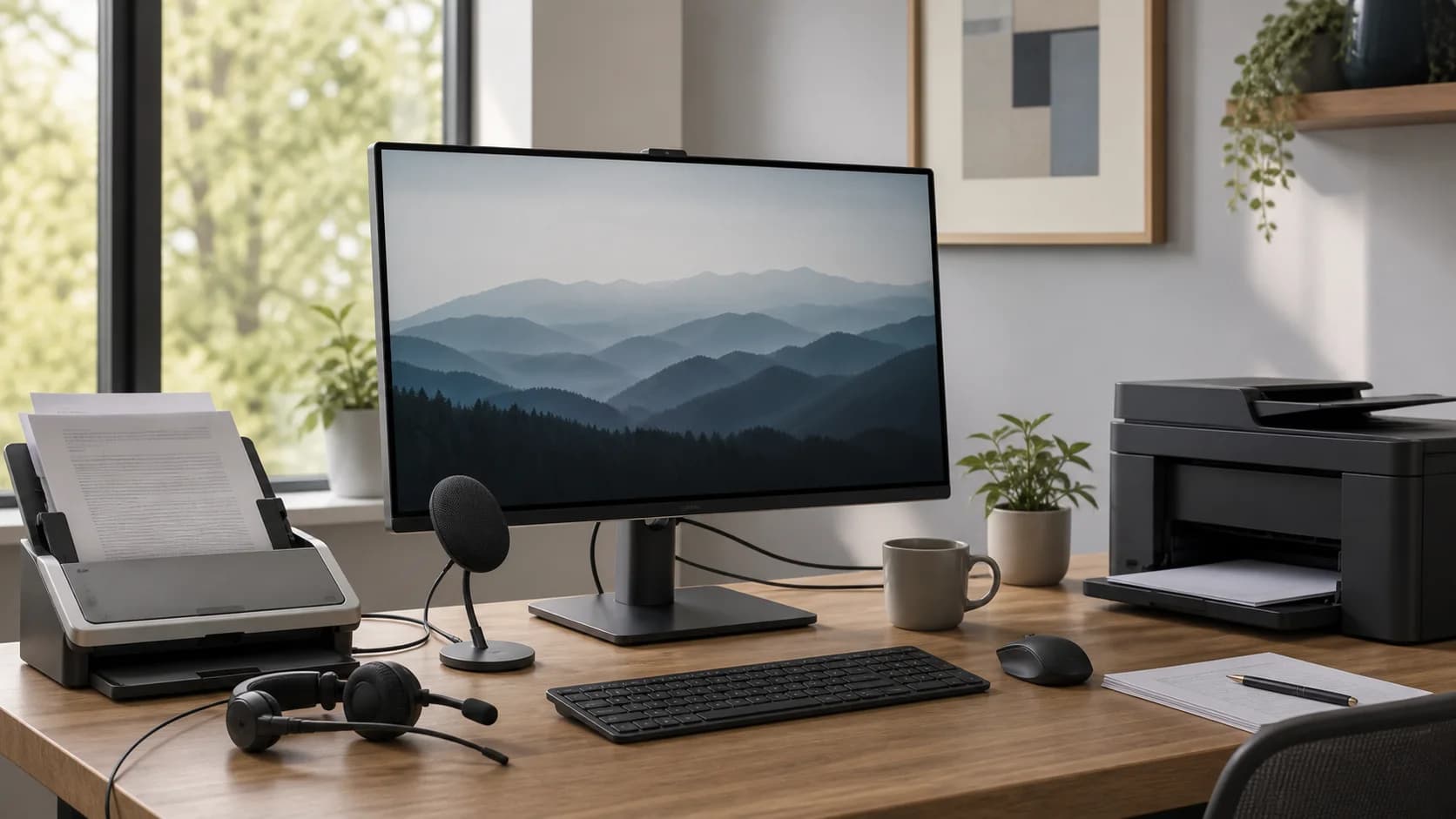
Sheet-fed document scanners: write a pass or fail for every fit check
Record one evidence-backed result beside each condition: duplex speed and automatic feeder capacity; receipt, card, and paper-size support; OCR and destination workflow; and roller access, misfeed detection, and driver support. “Probably compatible” is not a pass. Use the exact model or variant, measure the limiting real-world condition, and follow this reversible sequence: define file naming and destination first, test mixed paper, tune OCR, and scan a small batch before feeding important originals. Stop the fit assessment when most documents are bound, fragile, or oversized, volume is occasional, or a phone and existing multifunction printer already cover the workflow.
Compatibility check 1: duplex speed and automatic feeder capacity
For sheet-fed document scanners, record the exact value, standard, measurement, or supported condition behind duplex speed and automatic feeder capacity before checkout. A broad category label does not prove that the selected variant fits. Confirm the manufacturer, complete model, hardware revision, operating-system support, port layout, dimensions, power supply, and included cables rather than assuming similarly named products share limits.
Compatibility check 2: receipt, card, and paper-size support
Test receipt, card, and paper-size support across the actual desk, body position, computer, operating system, cable reach, workday, and shared-device routine—not a product-photo setup. If this sheet-fed document scanners fit depends on a driver, dock, cable, adapter, mount, power supply, operating-system feature, desk clearance, or assembly service, confirm the exact part, service, or behavior as part of compatibility.
Compatibility checks 3 and 4: OCR and destination workflow; roller access, misfeed detection, and driver support
For sheet-fed document scanners, OCR and destination workflow and roller access, misfeed detection, and driver support are the limiting conditions most likely to surface only after installation. Measure the smallest clearance, weakest connection, least compatible user or device, and the most demanding normal task. Passing an ideal bench test is not enough.
Prove fit in a reversible order
Use this sequence: define file naming and destination first, test mixed paper, tune OCR, and scan a small batch before feeding important originals. Keep labels, packaging, manuals, and the previous system until the product works through normal use and a recovery test. Photograph wiring, measurements, or assembly states that would be difficult to reconstruct.
A failed fit check is a stop signal
Stop when most documents are bound, fragile, or oversized, volume is occasional, or a phone and existing multifunction printer already cover the workflow. Do not repair a fundamental mismatch with unapproved accessories, copied settings, or community anecdotes. Use flatbed scanners or multifunction printers when it meets the job with a clearer compatibility path.