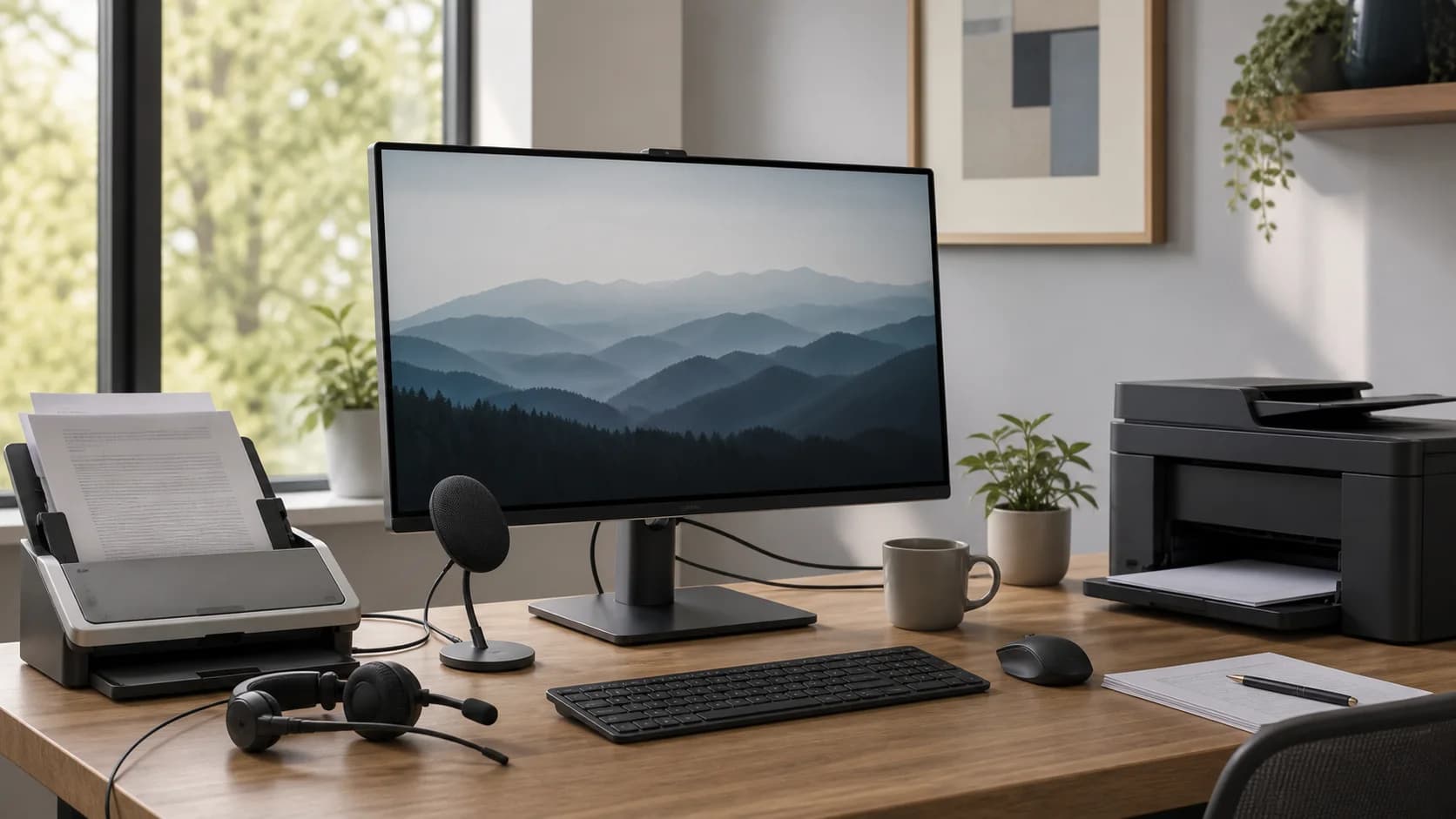
Map three real work layouts before comparing diagonal inches
Recreate the windows used for focused work, meetings and reference tasks. An ultrawide favors flexible side-by-side windows but can complicate sharing one full screen; dual monitors create a natural primary/secondary boundary but add a bezel, stand and cable path. Compare usable pixel dimensions, not only physical size, and check whether the camera, speakers and main application can remain centered without repeated neck rotation.
The real fork is specialized function versus dual monitors
ultrawide monitor win when they can replace two display workspaces with one wide canvas and fewer bezel interruptions and that function removes a known recurring problem. dual monitors win when they reach the same outcome with fewer dependencies, less maintenance, a more understandable failure mode, or a cleaner return path.
Normalize desk depth and viewing distance and resolution and operating-system scaling
Compare both paths across the same desk, body position, computer, operating system, cable reach, workday, and shared-device routine, with every required dependency included. A complete ultrawide monitor package should not be compared with an incomplete alternative, and a retailer headline should not replace product-level compatibility evidence.
Use curve, panel height, and text clarity and window management, webcam, and screen-sharing behavior as tie-breakers
In a ultrawide monitor comparison, curve, panel height, and text clarity and window management, webcam, and screen-sharing behavior reveal the friction that appears after an attractive demo. Choose the path that can be installed, used, cleaned, updated, and recovered by the people who will actually own it. Prefer the simpler failure mode when performance is otherwise close.
Compare ownership, not only purchase price
ultrawide monitor bring an ownership path of large-arm or stand cost, GPU bandwidth, cable reach, panel replacement risk, and adapting screen-share habits. Price that against the maintenance and replacement work of dual monitors over one normal year. Include the value of time and the cost of losing the service while a proprietary part, account, or repair is unavailable.
Make the choice reversible
Use this test path before the return window closes: measure the desk and sightline, test native resolution and scaling, set repeatable window zones, and rehearse sharing a single application in meetings. Preserve the old setup and packaging until the product survives normal use. Choose the alternative immediately when the desk is shallow, the work depends on physically separated full-screen sources, or text size becomes uncomfortable at native resolution.